Sample#
The Sample page records what was in the tube. Several tools read these fields — solvent referencing and suppression need the solvent, hydrodynamic radii need the temperature, and the repetition delay is derived from the anticipated T1 — so filling them in is not bookkeeping.
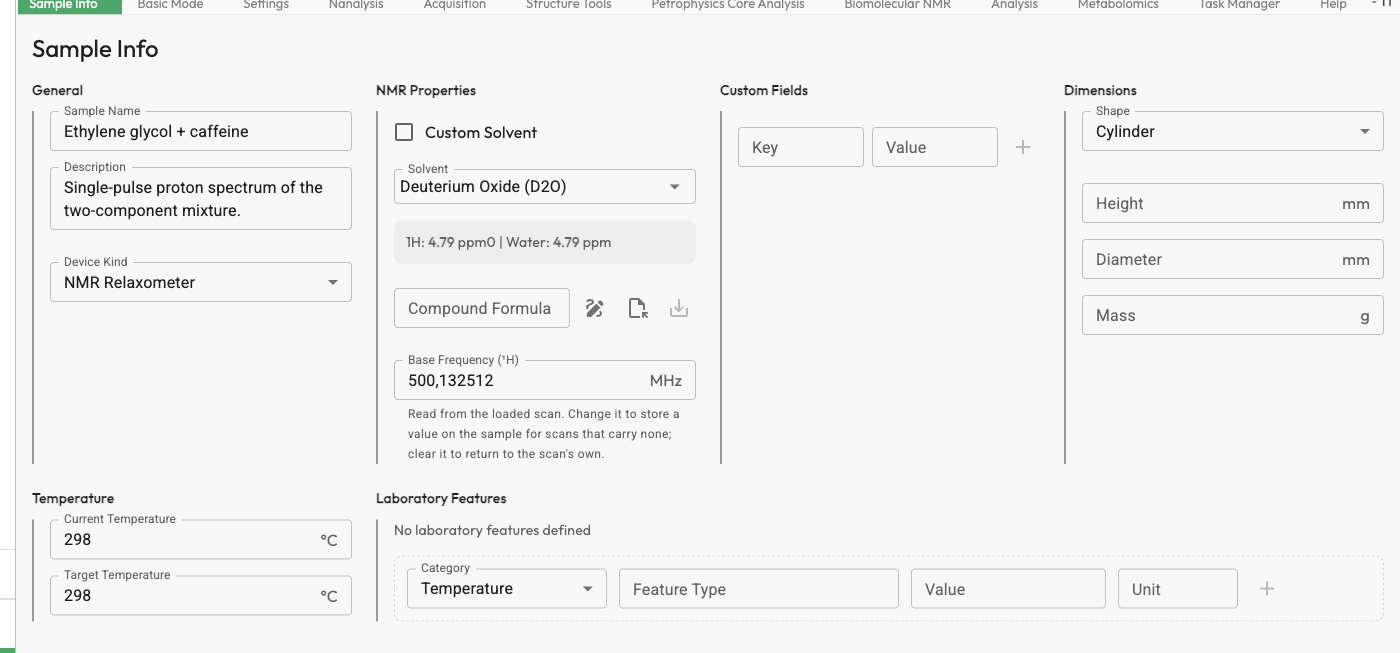
Each scan stores a snapshot of the sample as it stood when the scan was taken, so editing the sample later does not rewrite the history of data already recorded.
Which sample you are editing#
With no scan loaded the page edits the sample for the next acquisition. Once a scan is loaded (including the one a run has just finished) a switch at the top chooses between Next acquisition and Loaded scan:
Components#
Each compound in the tube is a component with a name, role, concentration and unit, and optionally a SMILES string or drawn structure. A mixture lists one component per row. Structure elucidation can write its accepted answer here.
General#
| Field | Notes |
|---|---|
| Sample name | Required. |
| Description | Free text — origin, preparation, purpose. |
| Device kind | The kind of instrument the sample is measured on. |
NMR properties#
| Field | Notes |
|---|---|
| Solvent | Determines the reference line. Without it the Reference to solvent and Subtract the solvent line tools in the spectrum view have nothing to work from, and the latter is shown disabled rather than hidden. |
| Shift reference | The reference compound and its shift, when the spectrum is referenced to something other than the solvent. |
| Base frequency (¹H) | The spectrometer frequency in MHz. The box shows the frequency the loaded scan carries; a value you type is stored on the sample and used only for scans that carry none. Clear the box to return to the scan's own. |
Acquisition#
Shown only while editing a loaded scan that recorded how it was acquired: instrument, probe, pulse program, scans, delays, pulse settings, temperature, operator, acquisition time and the dimensions of the data. This is a read-out of the scan, not something you set here.
Custom fields#
Free key and value pairs for anything else you want recorded with the sample. Removing a field asks for confirmation, because reports and analyses that read it will find nothing afterwards.
Temperature and dimensions#
Current and target temperature, the tube shape (cylinder or cube) with its dimensions, and the sample mass. Temperature matters beyond record-keeping: relaxation times depend on it, and DOSY needs it to convert a diffusion coefficient into a hydrodynamic radius. Switching the shape keeps the numbers of the other shape, so switching back restores them.
Laboratory features#
| Field | Notes |
|---|---|
| Category and feature type | The variable being tracked across a series — concentration, mass, empirical temperature, pH, viscosity and so on. |
| Value and unit | Its value for this sample. |
The anticipated and observed T1 and T2 live with the relaxation measurements, not on this page.
Where samples live#
Samples belong to a project and are listed in the Samples Explorer of the Data Browser, where you can also create and delete them.